
March 2026

Blog

What do people need to remember?

Introduction

We remember only a tiny fraction of our experiences. While we often say "I forgot X", most memories are not really forgotten—with the right cue, in the right setting, dormant memories can return to us spontaneously, effortlessly. However, we cannot recall most of our memories at will. For example, try recalling the names of all your classmates in first grade. This type of remembering, known as free recall, is quite challenging. Now, suppose instead that you only need to pick out your classmates' names from a list that includes your classmates among other names. You are likely to recognize many more of your classmates' names from this list than you can remember off the cuff. This is known as cued recall, and it is much easier than free recall.

Figure 1: Most personal memories are hard-to-recall "dark matter" of memory. All the information there is to know may be classified into three kinds. First is world knowledge, such as the name of the longest river in the world. Second is personal memories. Personal memories include some world knowledge, such as who the Secretary-General of the UN is. Nevertheless, many of our personal memories—say, the gift we bought for our parents with our first paycheck—are not world knowledge. Third is what we can easily remember from our personal memories. The vast majority of personal memories are hard to recall; they form the dark matter of memory.

Memories that are not really lost, but that are only accessible via the right cues, are the dark matter of memory. Like dark matter in the universe, the dark matter of memory is massive, ubiquitous, yet not directly observable (Figure 1). To begin to characterize the dark matter of memory, we collected a dataset of everyday memory questions in the wild (QITW)—questions about information people once knew, but can no longer recall. These questions are the most noticeable penumbra of the dark matter of memory.

Methodology

We asked 134 participants (46% female, ages 18–80, mean age: 41) to note down memory-related questions they had during daily activities. Memory-related questions were described as occasions when "you need to search for something you once knew." Detailed task instructions are included in Appendix 1. All participants were fluent in English; 86% were native speakers. The participants' occupations are summarized in Table 1. We recruited participants via the Prolific crowd-sourcing data collection platform. Participants indicated their written consent for completing the study and were compensated for their efforts.

From a total of 3,609 questions, we excluded questions that could be answered with just world knowledge, obtaining 1,940 personal memory questions. Participants asked a wide variety of questions. Examples include "Who is …?", "When did I last meet with …?", "What is my username and password to log in to …?", "Where is the folder with the current slide deck from …?", and "What did my manager ask me to do about …?". Additional example questions are shown in Appendix 2.

Gender
Male48%
Female46%
Not Specified6%
Age

Mean 41, Median 41, Range 18-80, Mostly 25-54.

Occupation
Management / leadership21%
Software / IT13%
Admin / Clerical8%
Unemployed8%
Trades / manual labor8%
Homemaker / caregiver6%
Freelance / self-employed5%
Education5%
Finance / accounting4%
Retail / Sales4%
Healthcare4%
Engineering3%
Students3%
Customer service2%
Government / public sector2%
Creative / media2%
Retired2%
Other1%
English Proficiency
Native86%
Fluent14%

Results

Word frequency highlights key themes including social interactions and time

We visualized the frequency of words across questions (Figure 2), excluding articles (e.g., "the"), verbs (e.g., "did"), and adjectives (e.g., "many"). Word frequency reveals many of the key themes in the data. People frequently asked about names, people ("name," "friend"), and time ("time," "year," "week," "date," "today"). People also often asked about exact details such as passwords, phone numbers, emails, birthdays, folders, and documents.
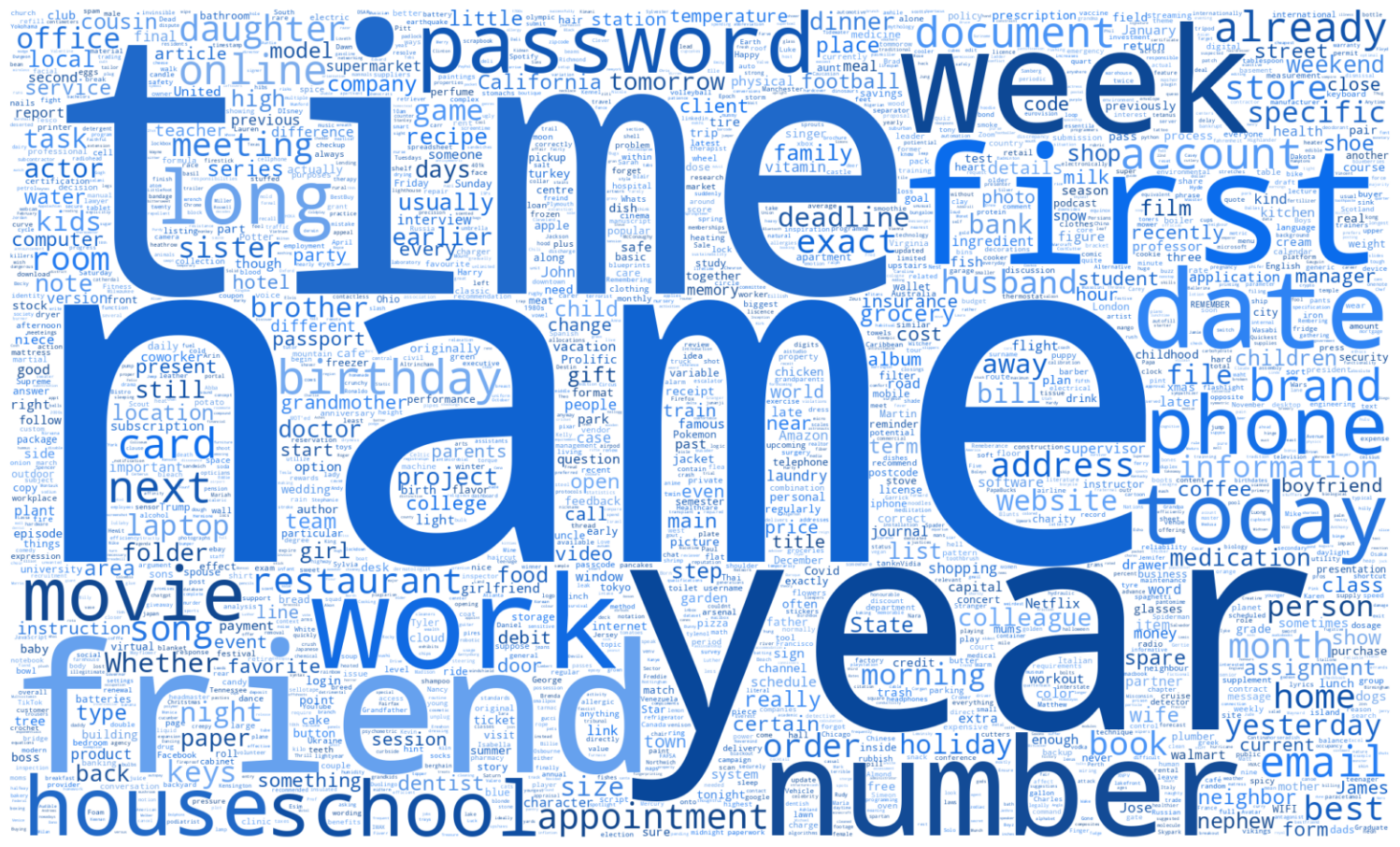
Word cloud of memory questions

Figure 2: A word cloud of memory questions reveals themes such as names, people, time, and exact information. The size of each word is proportional to its frequency of occurrence among the questions.

"What" questions were the most common

We classified the questions based on their primary intent: "What," "When," "Where," "How," "Who," "Why," or "Whether." This classification was based on not just syntax but also meaning using an LLM (gpt-5.2; the prompt is shown in Appendix 3). For example, "I wonder what is the name of the TV series [...]" was classified as a "What" question, while "What was the name of the person" was classified as a "Who" question. "What" questions were the most common by far, comprising approximately 40% of all questions (Figure 3).

Figure 3. Participants most frequently asked "What" questions. We classified questions by intent into "What," "When," "Whether," "Where," "How," "Who," or "Why." Each small dot indicates the fraction of questions a participant asked in a category. The size of each dot is proportional to the number of questions. Diamonds with whiskers indicate the across-subject averages with 95th-percentile confidence intervals.

Participants most frequently asked about their own past actions

We further categorized the QITWs into 18 detailed categories (including an "unassigned" null category for ambiguous questions). The categories were created by manually reviewing a representative subset of questions, and then applying the categorization scheme to the remaining questions using an LLM (gpt-5.2; the prompt is shown in Appendix 3). The most common questions were about participants' own past actions. Of these, most questions were about the recent past—hours or days before posing the question. The next most common questions were about contact information, followed by questions about schedules, object locations, and tasks.

Figure 4. People typically asked questions in a consistent mix of categories, most commonly about their own past actions. Questions about recent past actions (e.g., "What was the name of the cafe I visited last weekend?") were more common than questions about actions further in the past (e.g., "What present did I give my daughter on her 10th birthday?"). The next most frequent questions included contacts, plans, misplaced items, followed by personally relevant world-knowledge questions (e.g., tip-of-tongue questions). This figure follows the format of Figure 3.

Participants most often asked memory questions when working and planning events

The participants also recorded what they were doing when they had each memory question. These activities were grouped into 16 activity categories (Figure 5). About a fifth of the questions arose while people were working, followed by planning, socializing, and web browsing. The frequency of activities reflects both when memory questions occur and the general frequency of activities. Nevertheless, the range of activities demonstrate that memory needs pervade all aspects of life.

The type of memory question participants asked correlated strongly with what they were doing (Figure 6). We quantified the correlation between activity type and question type using odds ratios. For example, participants were 11 times more likely to ask about locations when traveling and 3 times more likely to ask about schedules when making plans. In these examples, the activity type congrues with the question category. Such congruent cases are plotted along the pseudo-diagonal in Figure 6 and account for a large portion of the questions. There were also notable cases outside of the congruent pairs. For example, watching TV and reading strongly triggered tip-of-tongue questions (6.2× and 5.8× more likely), while browsing the internet broadly triggered questions about account IDs (6.4×), passwords (4.3×), and trivia (2.4×).

Figure 5. Participants needed to recall information from memory across multiple activities, particularly when working and planning events. Each small dot indicates the fraction of questions a participant asked during an activity. The size of each dot indicates the number of questions that participants asked during that activity. Diamonds with whiskers indicate the across-subject averages with 95th-percentile confidence intervals. The most common activities when people asked memory questions were working (19.8%), planning/organizing (12.8%), and socializing (11.0%).

Figure 6. What participants were doing correlated strongly with the type of information they sought. Each row is one of 14 activity categories from Figure 5, and each column is one of the memory question categories from Figure 4. The rows and columns are sorted to align congruent pairs (where the activity naturally matches the question category; highlighted in orange borders) along the diagonal. Each cell shows the odds ratio, i.e., the odds that a particular type of memory question arises during a particular activity, relative to the odds that the question type comes up during other activities. The color scale is logarithmic and centered at 1× (white); blue indicates enrichment (higher odds), and grey indicates depletion (lower odds). Congruent pairs are highly enriched. For example, when cooking, people are 13.7× more likely to ask about recipes; people traveling are 11× more likely to ask about locations; and people planning are 3× more likely to ask about schedules. Off the diagonal, watching TV and reading both strongly trigger tip-of-tongue questions (6.2× and 5.8×), while browsing the internet leads to broad enrichment across questions about account IDs (6.4×), passwords (4.3×), and trivia (2.4×).

Discussion

Memories give color to our unique identities, yet most of our memories are usually hidden and inaccessible (Figure 1). To begin shedding light on the dark matter of memory, we collected questions that people ask daily about their memories, at work and in life. We refer to these questions as memory questions in the wild.

A large body of laboratory-based experiments has asked participants to memorize and recall information [2, 6, 8]. For example, studies have presented participants with lists of words and then asked them to recall those words after certain time intervals. By design, these experiments are impersonal, unlike the organic, deeply rooted memory questions people ask themselves daily. More recent studies have characterized memories of real-life experiences such as movie watching [4], city walks, and museum visits [5]. While these naturalistic experiments better capture the encoding and recall of real-world information, they remain specific to controlled experimental conditions that do not always reflect our actual memory needs. In contrast, here we characterized people's day-to-day memory needs.

These memory questions in the wild confirm several intuitions and reveal unexpected insights. People often asked about contact information such as emails and phone numbers, schedules, tasks, and passwords—categories for which we have invented dedicated tools, from physical planners and calendars to digital notes and keychains. Meanwhile, the questions reveal prevalent memory needs that remain ill-served. The most common questions ask about participants' own actions, among which the recent past ("What was the name of the cafe I visited last weekend?") features more often than the deeper past ("What present did I give my daughter on her 10th birthday?"). Participants tended to ask about the recent past perhaps because it is more relevant to them at the present moment. However, this recency bias can also arise whenever older events are harder to ask about—because those older events fade into the dark matter of memory. For example, a participant may not ask about the cafe visited on a certain weekend last year because they may not remember having visited a cafe on that weekend. Old memories are nevertheless precious, as diaries and autobiographies attest.

Memory questions pervade a broad range of activities throughout the day. When working, people ask about professional task knowledge. When socializing, people ask about acquaintances and contacts. Even when watching TV and movies, people ask tip-of-tongue questions about shows, films, and more. Besides the ongoing activity, myriad other factors, such as age, health, profession, company, and the time of day, influence our memories. Thus, this study is only an initial step toward characterizing memory questions in the wild. Future work may focus on work versus personal life, different professions, age groups, and more, leading to an ever more thorough and systematic understanding of people's memory needs.

An important direction of future work is to characterize the needs of people with progressive degrees of memory loss. Understanding those most in need of memory assistance can help improve their quality of life, and can be a crucial first step to develop a technology that improves memory for all.

The ubiquity of memory questions—what I know I knew (but can't remember)—only begins to peer into the dark matter of memory—what I don't know I knew. We can only realize, ask about, and search for information we partially remember. It is impossible to ask about events and topics we remember nothing about. By understanding people's observable memory needs and building tools to meet them, we are making inroads into revealing ever more of the hidden dark matter of memory.

References

(1) Eldridge M, Sellen A, Bekerian D. (1992). Memory Problems at Work: Their Range, Frequency and Severity. Technical Report EPC-1992-129.

(2) Kahana MJ. (2012). Foundations of Human Memory. Oxford University Press, New York.

(3) Fried I, Rutishauser U, Cerf M, Kreiman G. (2014). Single Neuron Studies of the Human Brain: Probing Cognition. MIT Press.

(4) Tang H, Singer J, Ison M, Pivazyan G, Romaine M, Frias R, Meller E, Boulin A, Carroll JD, Perron V, Dowcett S, Arlellano M, Kreiman G. (2016). Predicting episodic memory formation for movie events. Scientific Reports, 6:30175

(5) Misra P, Marconi A, Petterson M, Kreiman G. (2018) Minimal memory for details in real life events. Scientific Reports, 8, 16701

(6) Tulving E. (2002). Episodic memory: From mind to brain. Annual Review of Psychology, 53:1–25.

(7) Brewer WF, Treyens JC. (1981). Role of schemata in memory for places. Cognitive Psychology, 13(2):207–230

(8) Cohen G. (2008). Memory in the Real World, 3rd edition. Psychology Press.

(9) Cheke LG. (2016). What-where-when memory and encoding strategies in healthy ageing. Learning & Memory, 23:121–126.

(10) Cheke LG, Clayton NS. (2013). Do different tests of episodic memory produce consistent results in human adults? Learning & Memory, 20(9):491–498

(11) Sky CH-Wang, et al. (2025). Browsing lost unformed recollections: A benchmark for tip-of-the-tongue search and reasoning. Proceedings of the 63rd Annual Meeting of the Association for Computational Linguistics (Volume 1: Long Papers).

Appendix 1. Study instructions

What is QITW?

Questions in the wild (QITW) are all your memory-related questions:

  • Every time you have to search for something that you once knew
  • Every time you meet a person that you once met but you do not remember their name or some information about them
  • Every time you are working on something and forget information

There are no wrong questions; there are no small questions. Every question that should be in your memory but is not belongs in QITW.

Instructions

We are conducting a research project about memory. We are collecting data about what memories you need but can't remember throughout the day.

We would like to know about every time you need to search for something you once knew. Please be specific when describing your questions.

Please record these questions here as you come across them throughout the day.

Appendix 2. Examples categorized by question type

This appendix shows example questions submitted by participants, categorized in two ways: W-questions (Figure 3) and 18 detailed question categories (Figure 4). The questions are copied verbatim, except when modified to omit personal information.

W-questions

What/which

  • I was trying to remember the name of a specific game I'd played in order to purchase it as a gift for a friend.
  • What is the name of the Abba eurovision winner?
  • What is the name of the movie with the song White Christmas?

When

  • When is my train departing tomorrow?
  • What time does my child's volleyball practice start today?
  • When did I overhear a boy talking about how much he loved Trump in a bookstore?

How

  • How do you play UNO?
  • How did I prepare chicken soup last time?
  • Quickest bus route into town and service number

If/whether

  • Do I have any arborio rice left?
  • Did I make an alarm for Duolingo for Sundays?
  • Did I take my vitamins today?

Where

  • Where did I last put the sellotape?
  • Where did I leave my car keys?
  • Where did I put my liquid bandage medication?

Who

  • Who is Will in Stranger Things?
  • Who was my first boss?
  • What was the name of the person I spoke to from the recruitment agency?

Why

  • Why did I go to the kitchen. I am here, but I don't know why?
  • Why did I want to go to this store that I had planned to go to?
  • Why does a name my friend mentioned sound so familiar?

Eighteen (18) detailed categories

Recent past actions

  • A survey on Prolific asked me how much I donated to charity. Even though I donated regularly, I forgot how much I usually donate. I had to look at my past records. (I was working at my job, doing surveys during my break.)
  • If I took all my medication for the day (Looking at my daily pill box)
  • What was the movie I watched two weeks ago? (When watching another movie recently)

Autobiographical past

  • Where did my friends and I eat for that birthday last year? (Trying to suggest a restaurant)
  • The present I gave my daughter on her 10th birthday (I was having a conversation with a colleague about gifting.)
  • Did I move to California before or after I started surfing? (When I was thinking about my time in California)

Schedule/time

  • I forgot when I was supposed to pick my wife up from the bus station. I checked my phone for the information. (I was at my computer searching the internet.)
  • Remembering the client meeting date and time? (while checking my calender for upcoming meetings)
  • What time my dentist appointment is scheduled today (I was planning my afternoon errands)

Contacts (general information)

  • I forgot my friend's birthday. I asked him again. (I was at my friend's house.)
  • What was the name of the colleague I met at the cafe last weekend? (I was telling my partner about who I met.)
  • I needed to remember my neighbors name not her nickname (I was getting ready to text her to ask her a question.)

Tasks/to-do's

  • I forgot what groceries I needed to buy. I have an online account at grocery website. It has a list of my most needed items. (I was working at my job.)
  • I had a gift idea at some point... What was it? (Standing in a store, drawing a blank)
  • Remembering to submit the monthly sales report (while reviewing my emails at work)

Object location

  • Where are the car keys (Laying in bed watching tv)
  • where did I place my passport as it needs renewing soon? (I was tidying up my bedroom)
  • Where I parked my car at the gym (I was leaving after my workout)

Tip-of-tongue

  • The podcast I listened to that helped me with my healing process. (I was trying to recommend it to a colleague that was having a hard time moving on.)
  • What the name of the restaurant we liked last month (I was suggesting a place to eat with family)
  • The name of the tv drama that I have been watching for the last few days (When I go to speak to friends about it)

Trivial/factual

  • what channel to see my favorite tv show (When I get ready to see my tv show)
  • remembering the time difference for an international call (while scheduling an international call)
  • What the return policy was for a recent purchase (I was considering sending an item back)

Professional task knowledge

  • I needed to remember the format I used for the last client presentation. (I was discussing with my team how we can create the presentation slides, I wanted them to use the exact format I used for the last client.)
  • What document did I need to submit for my business application? (When checking emails earlier in the week)
  • Did I skip a step? (I was trying to figure out a problem and it wasn't coming out to the right answer?)

Digital file location/URLs

  • Which app had my digital coupons clipped already? (Standing in line at the store)
  • Where did I save the document I worked on last weekend? (I wanted to finish my work before the year ends.)
  • remembering where i saved the project file (while searching through my computer folders)

Procedures/how-to/recipes

  • I needed to remember what a martial arts instructor said. I found some older videos and skipped to the relevant information. I've seen this information many times before, but I still forgot. (I was looking at my notes about the martial art, and I had some questions.)
  • The exact recipe I used to make chicken curry sauce. (I tried making curry sauce for my mom on Christmas day and needed to use that same recipe because she loved it.)
  • I was knitting a hat for a little neighbor girl but it had been months since I had knit anything and actually had to look up a basic abbreviation. (I was home in my chair knitting a gift for a little girl, reading a knitting pattern.)

Passwords

  • I suddenly forgot the pin number for my debit card. I used it many times before, and I don't know why I just forgot it. I had to use another payment method. I remembered it later. (I was at a grocery store.)
  • What password did I use for my old email account? (I wanted to recover my old email.)
  • What is the exact WiFi password for my home router (I was trying to connect a new device to my home WiFi network)

Personal task knowledge

  • What was the dosage my doctor told me to stay on before my last refill? (I was thinking about my health history)
  • Which train line I usually take to work (I was checking travel times in the morning)
  • What are the clothing measurements for my children, when buying clothes (When I'm planning on going shopping)

Household objects and state

  • I collect action figures and sometimes I forget what I have. I had to look at my collection to make sure I don't buy the same figure again. (I was at home in my living room, relaxing.)
  • Did I buy enough milk for the week? (Going to the shops in my car)
  • I was trying to remember if I had any micro SD cards or just regular SD cards. (I was ready with the manual on a new AI birdhouse I received as a gift and it stated I needed a micro SD card.)

Others' contact/ID

  • What was that TikTok creator's username who posts easy dinner ideas? (Scrolling TikTok while planning dinner)
  • New phone number for my friend (When I called the old phone number for my friend)
  • The house address of a friend (I was about to go visit)

Own accounts/IDs

  • What's the email I used for that fitness app I signed up for last year? (I was trying to log into the app after a long period of time.)
  • My Healthcare Insurance policy number (On the phone with the Insurance agent)
  • What is my licence plate number (Paying for a parking ticket)

Event physical location

  • I forgot the location for another work meeting. I had to check my email. (I was working at my job.)
  • where did my boxing coach say i needed to be next weekend? (he said he would send me an email but i even sent a message and got no reply as it is soon)
  • where will my friend birthday party be (I look at my calendar with a star on a date)

Unassigned

  • The first one would be when waking up and trying to capture the dream(s) I had (Just waking up after sleep)
  • Did someone lie to me? (I sometimes get the feeling that someone has told me something once and then changed their story. I can't remember the details of what they told me before but I just get that feeling that the stories do not match.)
  • Whose turn is it this time? (When we are playing Uno and some people keep playing reverses it's hard to remember which way the play is going.)

Appendix 3. Prompt for categorizing questions

W-questions

You classify personal memory questions by their W-type question intent.

This scheme is meant for messy, real-world language: implicit questions, missing entities, vague references, and partial context are all common. Use both the question text (including explanatory comments inside it) and the contextDoing field. If a question does not fit a single category with high confidence, use unassigned.

Categories (use labels exactly)

who
Questions about people or agents: identity ("who is X?"), roles ("who's in charge?"), or recalling/recognizing a person ("I forget names of famous people" → implied request to identify people). Often requires entity resolution (which person) and disambiguation across many candidates. Include possessive questions that apply to people, e.g., "Whose turn is it?".
what/which
Questions about things, facts, properties, or content: definitions, names of objects and things (non-person), attributes, events-as-objects, or "what happened?" Includes retrieving or describing an entity when the type may be unclear ("what is that?") and can span from simple labels to multi-field structured answers. This includes questions about selection among options: "which one is mine?", "which approach is best?", even when the options are implicit. Include implied questions about what someone did or is to do, e.g., "forgetting to turn off the stove," "forgetting to bring X" (both implying oneself forgot), "to buy groceries" are "what" questions.
when
Questions about time: points ("what time does class start?"), time ranges ("when did it happen?"), schedules, deadlines, and temporal ordering ("when was it before/after?"). Frequently involves time zone assumptions, recurring events, relative time ("tomorrow"), and uncertain or approximate dates. When questions include phrasings like "what time," "at which point," "on what day," "at what age," etc.
where
Questions about the locations of objects and places (e.g., room number, address). Often needs mapping from vague references ("the English class") to a specific location. Include digital locations ("Where did I save the file").
why
Questions about reasons, causes, goals, or explanations: "why did this happen?" or "why should I do X?". Typically supports multiple plausible explanations and may require weighing evidence, intent, and alternative hypotheses rather than returning a single fact.
how
Questions about method, process, mechanism, procedures, or degree: "how do I...?", "how does it work?", "how many/how much/how long?". Answers often require step-by-step procedures, formulas, or operational detail and may depend on resources and constraints. Questions about the order of tasks/steps belong here.
if/whether
Questions about alternatives, usually binary. E.g., have I already done X? / Whether I have done X.
unassigned
Use when uncertain, mixed, or not clearly a question type. Includes digital file location (where do I find a file; what is the URL to X). Be reasonably conservative and prefer unassigned if the best label is unclear.

Rules

  • Choose exactly one category per question.
  • Treat implicit requests as questions when the intent is clear (e.g., forgetting a name implies a "who" request).
  • When multiple categories are plausible, pick the best fit only if it is clearly stronger than the alternatives; otherwise choose unassigned.
  • Be reasonably conservative; do not stretch to force a label.
  • Do not infer details that are not stated or implied by contextDoing.

Eighteen detailed categories

You classify personal memory questions into specific categories.

Input fields

  • question text: the question or note (may include explanatory comments in parentheses).
  • contextDoing: optional; what the person was doing when the question arose.

Task

Choose exactly one category label for each question.

Categories (use labels exactly)

passwords
Passwords and secret access strings (digital). Use for questions whose answer is a secret used to authenticate: password/passcode/PIN/security code. Examples: "What was the login password I used for my student portal last semester?" / "Trying to remember my password for Microsoft Excel." Not this: non-secret account identifiers (email/username) → own_account_identifiers.
own_account_identifiers
My own identifiers (digital). Use for recalling your own non-secret account identity fields: username, email used to sign up, account ID, @handle, student ID, etc. Example: "What email address did I use when I created my FAFSA account last year?" Not this: if it is a secret (password/PIN) → passwords. If it is someone else's contact identity → others_contact_identity.
others_contact_identity
Other people's contact fields and digital identity (physical+digital). Use for contactable identifiers for other people: phone number, email, street address, social handle, user ID, etc. Examples: "What's my cousin's new phone number?" / "What's her Instagram handle?" Not this: their name or other personal facts → contacts_general_info.
contacts_general_info
People I know: names plus other non-contact info (people). Use for info about personal contacts/acquaintances, including names and spellings, relationships, who someone is, and personal-event recollections involving known people. Examples: "I needed to remember how to spell the name of my youngest niece." / "What is the name of the neighbor who lives two houses down...?" Not this: phone/email/address/handles → others_contact_identity. If it is a famous person or not a personal contact and you are grasping for a name → tip_of_tongue.
schedule_time
My schedule and event times (time). Use for timing of the user's own scheduled events: class start times, appointments, shifts, deadlines as schedule facts. Example: "What time does my biology class start on Tuesdays this semester?" Not this: "Did I do X / when did I last do X?" → recent_past_actions. Not this: public hours like "Is the stock market open tomorrow?" → trivia_factual.
tasks_todos
Prospective intentions, reminders, to-do items (planning). Use for things the user intends/needs to do (often not phrased as a question): buy/pay/prepare/remember-to. Examples: "To buy bread for sandwiches (Preparing sandwiches to feed the homeless)" / "remembering to pay an important bill on time" Not this: "Did I already do it?" → recent_past_actions.
event_location_physical
Where an event took place or will take place (physical). Use for the physical location of an event (room, building, venue), where the event is the main thing (not an object). Example: "What room number was my English class in last semester?" Not this: where you put an object → object_location (lost/hidden) or household_state_objects (stable storage).
object_location
Where I put a specific object I cannot find (physical). Use for a particular physical object that is misplaced/hidden/left somewhere (often recently handled). Examples: "Where I put my cake box?" / "Where did I put the Candy canes I bought yesterday and then hid...?" Boundary vs household: if it is about normal storage/inventory ("which drawer usually has...") → household_state_objects.
household_state_objects
Household inventory, condition, and stable storage (physical). Use for household state: whether you have something, whether it is clean/available. Examples: "Whether I had any arborio rice left." / "Whether or not I had spare clean bedding ready...". Not this: a one-off lost item ("where did I put...") → object_location.
digital_file_location_urls
Where a digital artifact is stored or how to access it (digital). Use for "where" questions about digital locations: folder/file path, which app, drive location, link/URL, bookmark location. Example: "Where did I save the document for my SAP appeal form requirements?" Not this: recalling the name/title of a specific thing (not where it is) → tip_of_tongue.
procedures_howto_recipes
How to do something (general), recipes, durations (how-to). Use for procedural "how do I...", recipes used, step-by-step guidance, cooking times — not requiring professional domain context. Examples: "What recipe I used for a dish last week" / "how to do a re tune on my tv." / "How long does the pasta take?" Not this: specialized technical/workflow knowledge tied to a professional domain/tool → professional_task_knowledge.
professional_task_knowledge
Specialized work/school/technical task knowledge (professional). Use for domain-specific or job-specific knowledge needed to complete a professional/technical task (physics steps, software UI options, SKU lookup). Examples: "What was the next step supposed to be? (physics.)" / "Which tab or menu contains the option I need?" / "What is the SKU of..." Not this: everyday how-to without domain specificity → procedures_howto_recipes.
personal_task_knowledge
Specialized personal-life knowledge (health/regimens/etc.). Use for user-specific knowledge needed for personal life tasks — often health, caregiving, personal regimens — where the answer is not generic trivia. Example: "I needed to remember the names and exact dosages of the medications I take." Not this: general health facts ("Is it necessary to drink a gallon of water a day?") → trivia_factual.
recent_past_actions
What I did recently: did/when/which/how (episodic, recent). Use for recalling your own actions in the recent past (hours/days/weeks): whether you did something, when you did it, what you chose/bought, what you told someone, what you skipped. Examples: "when was last time i checked the spam folder" / "Did I remember to update my rental insurance?" / "Which workout days I skipped last week" Not this: long-ago life memories → autobiographical_past.
autobiographical_past
Remote personal history (months/years/childhood; "a while ago"). Use for memories from a substantive while ago: childhood, first pet, former job routines, places you used to go. Examples: "What fur pattern did my first cat have?" / "Where my childhood best friend and I used to go for bike rides" Not this: last week / last month-ish task check → recent_past_actions.
tip_of_tongue
Vague recall of a specific entity name/title (not a personal contact). Use for "I can describe it but cannot name it" retrieval: a famous person, game, character, product, article title — a specific entity but details are fuzzy. Examples: "Sometimes I forget names of famous people..." / "name of a specific game I'd played..." / "What is the name of the semi expensive ... machines? ...something Queen" Boundary: if the entity is a personal contact/acquaintance, prefer contacts_general_info. If it is asking for general facts (not a specific remembered entity), use trivia_factual.
trivia_factual
General world knowledge / Google-able facts (not personal memory). Use for factual or semantic questions not tied to the user's personal experience: definitions, history, public schedules/rules, general health/diet info, comparisons. Examples: "What year was the Gettysburg Address...?" / "what does EFT stand for?" / "Is the stock market open tomorrow?" / "How many weeks is a full term pregnancy...?" Not this: vague naming of a specific remembered thing → tip_of_tongue.
unassigned
None fit cleanly / too ambiguous. Use when no category fits with high confidence or overlap cannot be resolved without guessing. Be reasonably conservative and choose unassigned if the best label is unclear.

Core rules

  • Choose exactly one category per question.
  • Consider BOTH the question (including any parentheses) and the contextDoing field.
  • Prefer unassigned whenever there is any doubt or overlap; be reasonably conservative.
  • Do not infer details not stated or clearly implied by the question or contextDoing.

Tie-break guidance (still prefer unassigned if uncertain)

  1. If it is a password/PIN/passcode → passwords.
  2. If it is the user's own email/username/ID/@handle → own_account_identifiers.
  3. If it is someone else's phone/email/address/handle → others_contact_identity.
  4. If it is "where did I save/link/URL" → digital_file_location_urls.
  5. If it is "did I / when did I last" about the user's behavior → recent_past_actions.